January 15, 2025 • Luka Karsten Breitig • 9 min read
Why Conversational AI Changes Everything About Google Ads Management
Friday, 4:47pm. Your boss drops by your desk.
“We need to launch a winter sale campaign. Target returning customers. Focus on conversions. £2,000 budget. Can you have it live by Monday?”
Traditional reality: You spend your weekend navigating 14 different Google Ads screens, cross-referencing audience segments, manually configuring bid strategies, and second-guessing every setting because the interface makes it nearly impossible to see the big picture.
Conversational AI reality: You type: “Create a winter sale campaign targeting returning customers, conversion-focused, £2,000 budget.” 47 seconds later, you’re reviewing a complete campaign structure with full explanations. You approve. It’s live. Your weekend is saved.
This isn’t science fiction. This is why conversational AI is fundamentally reshaping campaign management.
The Hidden Tax You’re Paying Every Single Day
Here’s what no one talks about: Google Ads isn’t designed for human thinking. It’s designed for Google’s taxonomy.
You don’t think in terms of “campaign settings > bidding > conversion actions > audience signals > ad group structures.” You think in terms of business objectives.
- “I need more qualified leads from the healthcare sector”
- “We’re launching a new product line and need brand awareness”
- “Our Q4 promotion needs to hit 400 conversions at £15 CPA”
But translating those strategic goals into the 47 different settings, toggles, and configurations scattered across Google’s interface? That’s not marketing. That’s archaeological excavation through a labyrinth of menus.
The average campaign setup takes 45-60 minutes of clicking, scrolling, toggling, and praying you didn’t miss a critical setting buried three levels deep.
And that’s just setup. Don’t even start on optimization, which requires navigating back through that same labyrinth to implement each individual change.
Let’s be honest about what traditional Google Ads management actually looks like:
Monday Morning: Campaign Performance Review
- Log into Google Ads (wait for dashboards to load)
- Navigate to Campaigns tab
- Click into Campaign A to review performance
- Switch to Keywords tab to identify underperformers
- Switch to Audiences tab to check segment performance
- Switch to Ad Groups to evaluate structure
- Navigate back to Campaigns
- Repeat for Campaigns B, C, D…
- Make mental notes of needed changes
- Start implementation by clicking back into Campaign A…
By 11:30am, you’ve optimized 2 campaigns and your brain hurts.
The interface forces you to think in fragments. You can’t see the forest for the trees. Strategic thinking gets buried under tactical navigation.
Why Chat Changes Everything (And It’s Not What You Think)
Most people assume conversational AI is about “convenience” or “speed.” Those are nice benefits, but they miss the fundamental shift:
Chat-based management aligns with human strategic thinking—not platform taxonomy.
Instead of translating your strategy into Google’s language, you express your intent naturally and the AI handles the translation.
The Old Way: Human Adapts to Platform
You: [Thinking] “I need to increase conversions for winter sale while maintaining CPA below £15”
Process:
- Navigate to campaign settings
- Consider: Manual CPC? Target CPA? Maximize conversions?
- If Target CPA: Navigate to bidding strategy
- Set target to £15
- Navigate to ad schedule
- Adjust for peak sale days
- Navigate to audience segments
- Adjust targeting for winter buyers
- Navigate to ads tab
- Draft new seasonal creative
- Submit and hope you didn’t miss anything
Time investment: 35-40 minutes per campaign
The New Way: AI Adapts to You
You: “I need to increase conversions for our winter sale campaign while keeping CPA below £15. Focus on the November 20-December 10 window.”
AI Response (23 seconds later):
“I’ve analyzed your account and recommend these optimizations:
Campaign: Winter Sale 2024
- Switch to Target CPA bidding at £14.50 (slight buffer below your £15 threshold)
- Increase budget by 18% during Nov 27-Dec 3 (historically your peak conversion window)
- Add custom audience segment: ‘Winter Sale 2023 Converters’ (847 users, historically 34% higher conversion rate)
- Update ad copy to emphasize limited-time nature (A/B test against current creative)
Expected impact: 24-28% conversion increase, CPA maintained between £13.20-£14.80
Approve all, or review individually?“
Time investment: 90 seconds to review and approve
See the difference? Same strategic goal. Radically different execution path.
The Three Hidden Benefits No One Talks About
Beyond speed and ease, conversational AI delivers three game-changing advantages:
1. Complete Transparency (Finally)
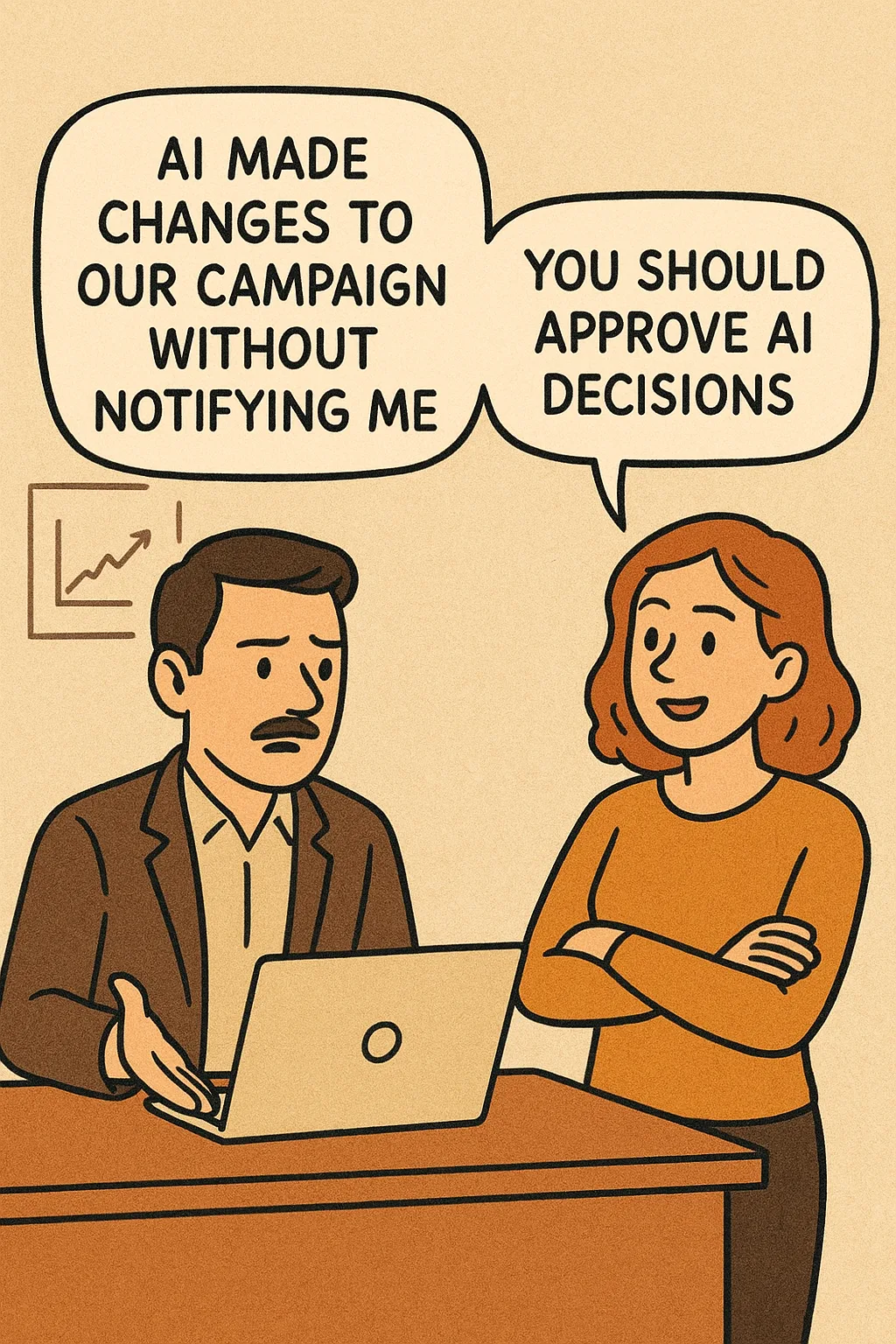
Traditional automation tools make changes in the background. You discover them when performance shifts—or worse, when your client asks about them.
Conversational AI presents every recommendation before implementation, with full reasoning:
- What data informed the decision
- What patterns were identified
- What alternatives were considered
- Why this specific approach was selected
- What outcomes are expected
You’re never surprised. You’re never caught off-guard. You’re never explaining changes you didn’t fully understand.
2. Strategic Context Stays Front and Center
Traditional interfaces fragment your thinking: You’re in “Keywords Mode” or “Ad Creative Mode” or “Bidding Strategy Mode.”
Conversational AI keeps the strategic context visible throughout:
You: “This campaign isn’t hitting our CPA target. What’s the issue?”
AI: “Analysis shows three contributing factors:
- Keyword ‘winter sale deals’ has £22.40 CPA (74% above target) due to high competition during your active hours
- Mobile traffic converting at 41% lower rate than desktop
- Ad schedule not aligned with your peak conversion windows (data shows 2pm-5pm significantly outperforms)
Recommended approach: Reduce bids on mobile for problem keyword, shift 30% of budget to 2pm-5pm window, and test desktop-specific landing page.
Expected impact: CPA reduction to £14.20-£15.80 range within 7 days.”
You’re not navigating tabs. You’re having a strategic conversation about business objectives backed by data.
3. Institutional Knowledge Gets Preserved
What happens when your Google Ads expert leaves? Or when you’re training a new team member?
With traditional management, expertise lives in people’s heads: the specific settings combinations that work, the bidding strategies that performed well, the audience segments worth testing.
With conversational AI, every decision is documented with reasoning. The strategic logic becomes searchable history:
“Show me why we chose Target CPA for Campaign X” “What was the rationale behind our winter sale audience segment?” “Walk me through how we optimized our Q3 campaigns”
Your strategic knowledge becomes a permanent, accessible asset—not a brain-drain risk.
The Agency Advantage: Client Communication Transformed
If you’re running an agency, conversational AI doesn’t just improve campaign management. It transforms client relationships.
Before:
Client: “Why did you change our bidding strategy?”
You: “Google’s algorithm recommended it based on performance data. It’s a best practice.”
Client: [Unimpressed, questioning your value]
After:
Client: “Why did you change our bidding strategy?”
You: “Great question. Here’s the full strategic rationale: Your campaign was running Manual CPC at £1.20 per click. Over 30 days, we tracked 2,847 clicks generating 89 conversions—£32.17 CPA, which is 28% above your target.
Our AI analysis identified that your conversion rate varied dramatically by time of day and device. Rather than continue overspending on low-converting segments, we recommended Target CPA bidding at £25, which allows Google’s algorithm to optimize bids in real-time based on conversion likelihood.
We’ve been testing this for 14 days. Results: CPA dropped to £24.30, conversion volume increased by 17%, and your overall ROAS improved by 22%.
Here’s the detailed performance comparison…”
Client: [Renews contract, refers colleague]
Same change. Completely different professional positioning.
The Real Question: Why Aren’t You Using This Yet?
Every day you’re managing Google Ads through the traditional interface, you’re paying three costs:
-
Time Cost – Hours spent navigating menus, clicking through tabs, manually configuring settings that could be expressed in a single sentence
-
Cognitive Cost – Mental energy spent remembering where settings live, what combinations work, and whether you’ve missed something critical
-
Strategic Cost – Fragmented thinking that keeps you in tactical execution mode rather than strategic optimization mode
Conversational AI eliminates all three.
But here’s what really matters: Your competitors are already making this shift.
The agencies and in-house teams winning pitches and retaining clients aren’t the ones with the most Google Ads certifications or the biggest team. They’re the ones who can combine AI-powered analysis with strategic communication and transparent decision-making.
They’re the ones who can say: “Here’s what the data shows, here’s what we recommend, here’s why it makes sense for your business, and here’s how we’ll measure success.”
That’s only possible when your AI workflow aligns with human strategic thinking—not platform taxonomy.
The Migration Path (Easier Than You Think)
You don’t need to rebuild your entire workflow overnight. Here’s how successful teams are making the transition:
Week 1-2: Start using conversational AI for new campaign creation. Keep existing campaigns in traditional management. Compare setup time and mental effort.
Week 3-4: Begin using conversational analysis for performance reviews. Ask questions like “Which campaigns are underperforming and why?” Compare insight depth to manual review.
Week 5-6: Implement AI recommendations for existing campaign optimizations. Maintain approval workflow to stay in control.
Week 7+: Gradually shift more optimization work to conversational interface. Notice how much time you’re reclaiming for actual strategic thinking.
Most teams report being 70-80% conversational within 6-8 weeks, with the remaining 20% being edge cases that still require traditional interface access.
The transition isn’t disruptive. It’s liberating.
Your Strategic Choice: Navigate Menus or Drive Results?
The marketing profession is splitting into two groups right now:
Group A continues spending hours navigating platform interfaces, translating strategic intent into tactical settings, and explaining why they can’t move faster on campaign optimizations.
Group B expresses strategic intent conversationally, receives AI-powered recommendations with full transparency, and maintains complete control while operating at 10x the speed.
Which group do you think clients will choose? Which group will justify premium rates? Which group will shape the next decade of digital marketing?
The tools exist today. The question isn’t whether conversational AI will become the standard for campaign management—it will. The question is whether you’ll be an early adopter who gains competitive advantage, or a late adapter scrambling to catch up.
Your campaigns don’t need more manual configuration. They need more strategic thinking.
Conversational AI doesn’t replace your expertise. It amplifies it by removing the interface friction that buries strategic thinking under tactical execution.
The future of Google Ads management isn’t more menus to navigate. It’s more clarity, transparency, and strategic alignment.
And that future is available right now.